
The study of the pastoral methods evolved by the foreign missionaries in Vellore Diocese in 19th and 20th centuries calls for a glance at and a grasp of geographic, historical, social, economic, political, cultural and religious realities of the times. Therefore, it is necessary to make a situation-analysis through available literature, documents, and personal interviews.
The region called “North Arcot District” experienced many a change under political and social influences. In the course of time, the North Arcot District was divided into two districts, namely Vellore and Thiruvannamalai for better administration. The Catholic diocese of Vellore is comprised of the above two districts. In this chapter, a brief historical overview on North Arcot (which has seen kings and kingdoms, battles, victories and defeats, growths and destructions) is presented along with some geophysical, environmental and demographic details proper to this region.
In the region, for about 200 years, there were countless changes in the way of formation of kingdoms and their capitals. The ‘North’ and the ‘South’ regions of Arcot came into the political map in 1810 at the time of the last Mughal Emperor. Later in 1908, the two districts namely North and South Arcot came into existence. Chittoor (Now in Andhra Pradesh) was the first capital of the North Arcot district. From then on, it was the principal military base of the British. In 1911, Vellore became the head quarters of North Arcot Dt. comprising Vellore and Thiruvannamalai.
There were frequent changes in regional boundaries between 1911 and 1956. When new states were created after the Independence, the North Arcot District comprised mainly of Vellore and Thiruvannamalai regions. For administrative reasons, in 1989, North Arcot District was divided into two districts, namely ‘North Arcot Ambedkar District’, having Vellore as its capital and ‘Thiruvannamalai Sambuvarayar District’ having Thiruvannamalai as its capital.
During the 1980s, districts were named after great leaders to commemorate their memory and pay tribute for their distinguished service. This trend created social unrest and occasionally rampant violence based on caste. Claims and demands were in plenty from all over to name public transport corporations and districts after political and popular leaders and these claims and demands sparked off the fire of casteism.
As communal violence was on increase, the Government of Tamil Nadu under the Chief-ministership of M. Karunanidhi, on July 2, 1997, removed the names of persons from the district names, and renamed them after the capitals of the districts.
These two districts of Vellore and Thiruvannamalai form the Catholic Diocese of Vellore. Henceforth, whenever the word ‘North Arcot’ occurs in this dissertation, it denotes Vellore and Thiruvannamalai districts. The Taluks of Vellore, Arakonam, Walajah, Arcot, Gudiyatham, Katpadi, Vaniambadi and Tirupattur are in Vellore district, while Thiruvannamalai, Chengam, Arni, Polur, Cheyyar and Vandavasi taluks are in Thiruvannamalai district.
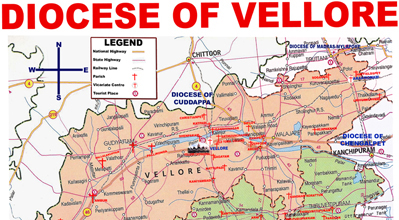
By the Apostolic constitution ‘Ex Primaevae Ecclesiae’ of November 13, 1952, when the Archdiocese of Madras and the Diocese of Mylapore were amalgamated and made into the Archdiocese of Madras – Mylapore, the southern portion of the Diocese of Mylapore was erected as the Diocese of Tanjavur, while North Arcot District (excluding its two taluks of chengam and Thiruvannamalai which were still under the Archdiocese of Pondicherry), a part of the District of Chittoor i.e the two taluks of Palmaner and Chittoor and the Taluk of Tiruthanni (at present in the District of Chinglepet) were detached from the old Archdiocese of Madras and were created as the ‘Diocese of Vellore’.

The new diocese of Vellore was entrusted to the Salesians of Don Bosco. According to the same constitution, the Most Rev. Paul Mariaselvam SDB, of sacred memory, was appointed the first Bishop of the Diocese of Vellore. He was consecrated on 19th of March 1953.
In the newly erected diocese, many were the difficulties that confronted him. He did not even have a residence. He had to be in a rented house. Practically all the catechists of the diocese had to be paid; new chapels and presbyteries had to be built. The finance was at very low ebb. However, Mary Help of Christians was his guiding Star. With Zeal, he set to work. He visited most of the mission stations. His first and foremost attention was to bring a renewal in the teaching of Christian doctrine to the school children and to get good and efficient catechists for evangelization. One could say that he was burnt up by the zeal for souls. His premature death on June 25, 1954, was a severe blow to the ‘Infant Diocese’ and its flock. Within the short span of 15 months as Bishop of Vellore, he endeared himself to all. His mortal remains were placed at the sanctuary of the Assumption Cathedral, Vellore on 26th June 1954.
After the demise of the first Bishop of Vellore, his Vicar General Msgr. S. David Marianayagam SDB became the Administrator of the Diocese of Vellore from July 1954 onwards. He was appointed Apostolic Administrator of the Diocese of Vellore. This was informed to the councilors on October 14, 1954. On July 05, 1956 he was nominated as the Bishop of Vellore. His consecration took place on the September 09, 1956. The Most Rev. Dr. Louis Mathias SDB, Archbishop of Madras – Mylapore, was the Principal Consecrator Bishop.

During the thirteen years of his bishopric, with the motto, ‘Let Jesus and Mary Reign’, he gave his heart and soul to his flock. He gave new look to the Assumption Cathedral; drew up a programme for the social uplift of a widespread nature. Many catechists were appointed to help in the work of evangelization. Besides, he was responsible for the construction of seven churches, 50 chapels, nine presbyteries and seven convents; he renewed and remodeled many churches and institutions; he saw that a sum of money was given to each parish for social work. All this good work shows his zeal for the spreading of Christ’s Kingdom on earth. But on Wednesday, July 16, 1969 at 3.30 p.m. he died of heart failure in the Bishop’s House of Kumbakonam Diocese. The funeral service took place in the Assumption cathedral, Vellore, on Friday, July 18, 1969 at 5.00 p.m.
Bishop Rayappan Antony Muthu – Third Bishop of Vellore (1971 – 1980) Bishop Rayappan Antony MuthuThe See became vacant and Msgr. S. Lazar, SDB, as Vicar Capitular, administered the Diocese ably for 21 months.
In an effort to bring the diocesan boundaries in line with the civil district the Taluk of Tiruthani in the District of Chingleput belonging to the Diocese of Vellore was detached from it and added to the Archdiocese of Madras – Mylapore, and the Taluks of Thiruvannamalai and Chengam in the District of North Arcot till then still belonging to the Archdiocese of Pondicherry-Cuddalore were detached from it and added to the Diocese of Vellore. (Decree Prot. No.404/69 1st September 1969 of the Sacred Congregation for the Evangelization of Peoples).

On March 06, 1971, The Most Rev. Rayappan Antony Muthu was nominated as the Bishop of Vellore. He was consecrated Bishop on April 21, 1971. In his efforts to help the priests, his co-workers in the parishes, and for the good of souls, he contacted many congregations of sisters and established not less than 24 convents in the Diocese of Vellore. To crown them all he succeeded in getting established Perpetual Adoration Monastery of Sisters of Poor Clare at Rangapuram, Sathuvachary where prayers are offered 24 hours a day for Diocese. He also erected 17 new parishes. He also saw to the needs of the retired priests in getting a house constructed at Sathuvachary, Vellore.
To provide for the needs of the people who are sick, he built about 21 dispensaries. He also developed the economic condition of the people by providing them with sewing machines, bulls, cows, goats and sheeps.
Mother and Child welfare programme was well organized with the help of CRS. It is during his time, by a Decree Prot. No.218/75 dated 20th January 1975, of the Sacred Congregation for the Evangelization of Peoples, that the five taluks of the civil district of Chittoor, namely Chittoor, Palmaner, Kuppam, Bangaupalam and Satyavedu belonging to the Diocese of Vellore were detached from it and added to the Diocese of Nellore, Andra Pradesh. From now on the old civil territory of North Arcot district which is now Vellore District and Tiruvannamalai District comprise the Diocese of Vellore. After his untiring work of ten years, Bishop Antony Muthu of sacred memory was called to eternal reward on December 19, 1980. The next day the Diocesan Council met and elected Very Rev. Msgr. S.T. Ignatius, the then Vicar General of the Diocese to the Vicar Capitular. The Diocese was ably administered by him for seven months.
Bishop Michael AugustineOn the July 10, 1981, Most. Rev. Dr. S. Michael Augustine, till then Auxiliary Bishop of Madras – Mylapore, was nominated as the fourth Bishop of the Diocese of Vellore. The Installation service took place on July 24, 1981 at 6.00 p.m. in the Cathedral Campus at Vellore.
Bishop S. Michael Augustine was the Bishop of Vellore for 10 years and 11 months. During his tenure of office, about 100 churches and chapels were built; seven new parishes were erected, six convents and dispensaries and three High Schools were opened, and five Elementary Schools were upgraded to middle schools.
He noticed that Catholics do not hold high positions. To achieve this, He started summer coaching classes for the students who finished school. This coaching classes helped many people to go for medicine, nursing, engineering and other technical trainings. He has also established a scholarship fund for professional studies. The children should have strong foundation in their education. So he started coaching classes for High School children. The coaching classes were conducted for a month. The whole expenses were met by the projects and Diocesan contributions.

The future of the Diocese depends upon the priests we get. To foster local vocations, he started a minor seminary at Pathiavaram. As the Tamil Nadu Bishops decided to have the college education as minimum qualification for major seminary admission, a seminary was started at Koviloor. The students attend Sacred Heart College, Tirupattur. At present, The minor seminary is at Vepur. Only students who have finished their plus two (+2) studies are admitted. After two years of minor seminary course, the students are sent to Tirupattur College for degree course. Home for Homeless: with this view, he built houses for the poor people. A loan scheme was started to help the teachers to build their houses. About 300 teachers have benefited by this scheme. With the help of Austrian youth, four dispensaries were started in interior villages. A Retreat House was started by ‘Foyer de Charite’. This is one of the Power Houses. Several Retreats and Seminars are conducted here. The separated brethren too come here for their spiritual renewal. He was transferred as Archbishop of Pondicherry – Cuddalore on March 24, 1992. He remained administrator of Vellore Diocese till June 25, 1992. When Bishop Michael Augustine took charge of Pondicherry Archdiocese, the Diocese of Vellore became vacant. The Diocesan Consultors had their meeting and elected, Rev. Msgr. A. Nambikairaj as the Administrator of the Diocese of Vellore. The diocese was ably administered by him for 20 months.
After 18 months of vacancy, Very Rev. Fr. A. Malayappan Chinnappa SDB, M.A. B.Ed, from K. Pudur, Madurai Archdiocese was appointed Bishop of Vellore. This good news was announced on December 16, 1993. He is the fifth bishop of Vellore and the third Salesian Bishop. The Episcopal Ordination was held on January 25, 1994. Simon Cardinal Lourdusamy was the main consecrator. All the Bishops of Tamilnadu were present. More than 400 priests were present. A good number of Sisters, Religious and lay people were present for the Episcopal Ordination.

In 1911, North Arcot District was erected and Vellore was named as its headquarters. In 1989, North Arcot was bifurcated into two Districts Vellore and Thiruvannamalai. From that time onwards, Vellore Diocese comprises of two districts namely Vellore and Thiruvannamalai. These two districts get less rain; Most of the fields are dry lands. There are two rivers and a few tributaries; they are dry throughout the year. There are no factories or industries. Once upon a time, Vellore district was famous for tannery works. Now the tanneries are mechanized and so no work; Matchbox works and Beedi (country cigars) works are done here. In this situation, only education can help these people.
When he was appointed Bishop of Vellore, his main priority was “Education for everybody”. He tried his best to educate all children, raised funds by scholarship and sponsorship etc. and put up good buildings for the schools. He also upgraded several schools that the children may study in the local school. This has helped to reduce the dropouts.
To cater to the needs of more people in rural areas, 17 new parishes and two mission stations with resident priests are erected. In 1997, his Sacerdotal Silver Jubilee was celebrated. All that time, the Tamilnadu Bishops’ Council meeting was held in Vellore. As a remembrance, Rs. 2.5 million was collected and the interest is used to help as medical aid to the poor people and widows received proper care. Care of souls is done with Pastoral Plans. Administrative and Cultural buildings are put up. In 2001, He defended a thesis at Madras University – Chair of Christianity and obtained a Ph.D. (on the Pastoral Methods of missionaries especially Paris Foreign Missionaries and the Salesians of Don Bosco). To provide opportunities for higher education, he has invited Sisters of Immaculate Heart of Mary to start University Study Centre, Carmelite Sisters to similar work and the Sisters of Gonzague to start Teachers Training College in different parts of the diocese. Priests, Religious and Laity do receive periodical animation programmes. To cater to the socio-economic developments of the people, one more Social Service Society is established at Thiruvannamalai. Eradication of Casteism is one of its landmarks. The diocesan synod is to be celebrated between September 9 and 13, 2003 with “Building relationships in Dialogue” as the main theme.
In July 10, 2002, one of the Diocesan Priests Most Rev. Dr. L. Thomas Aquinas was appointed Bishop of Coimbatore. He is the first one to be raised from Vellore Diocesan clergy to the Bishopric. His Episcopal Ordination was well attended by the Priests, Religious and laity. The new Assumption Cathedral (as said earlier) stands as a historical and an architectural monument.
There is a saying that North Arcot District faces famine every third year and flood in the seventh year. For the past four years, we are facing less and less rain. Yet we carry on to do the work of God.